You are ready to source from Yiwu. You have a product list, a budget, and a timeline. Then comes the question every buyer asks: how much does a Yiwu sourcing agent actually cost?
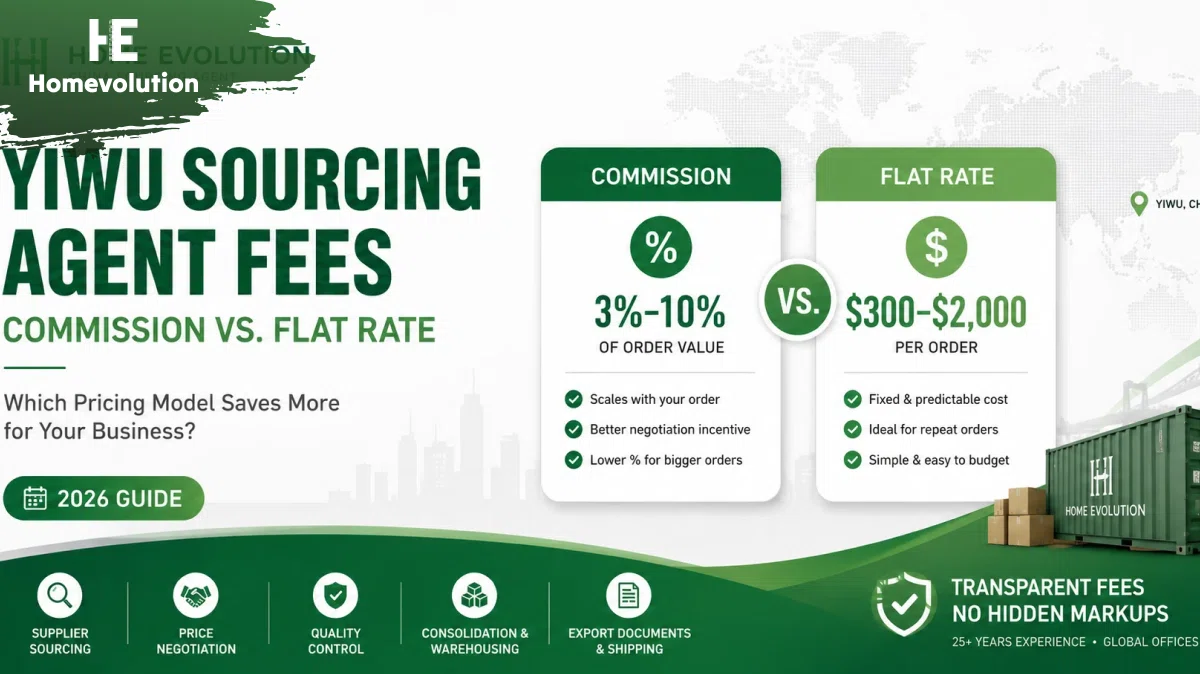
The answer is not a single number. Yiwu agent fees range from 3% to 10% commission on your order value — or $300 to $2,000 flat per order. The spread depends on your pricing model, order size, and what services you need. The smarter question is not “what is the cheapest rate?” It is “which pricing model costs me less for my specific order?”
We break down every Yiwu agent fee structure with real numbers — not ranges pulled from thin air. You will see a side-by-side cost comparison across actual order sizes, an interactive calculator that gives you dollar figures for your specific situation, and the pricing warning signs that cost unaware buyers thousands per order.
Key Takeaway: The lowest commission percentage rarely equals the lowest total cost. A 5% transparent commission often costs less than a “1% commission” that hides supplier markups. Always compare total landed cost — not just the fee percentage.
1. How Commission-Based Pricing Works
Commission is the most common pricing model among Yiwu sourcing agents. There is a reason for that: it ties the agent’s earnings directly to your order size. When you buy more, they earn more. That gives them a real financial reason to help you find better products at better prices — because your growth is their growth.
Under this model, the agent charges a percentage of your total product order value (FOB Yiwu). Freight and shipping costs are excluded from the calculation. Here are the standard industry tiers:
| Order Value (FOB Yiwu) | Typical Commission Range | Example Fee | Best For |
|---|---|---|---|
| Under $5,000 | 8% – 10% | $400 – $500 on $5,000 | First-time buyers, sample orders |
| $5,000 – $20,000 | 8% – 10% | $800 – $2,000 on $20,000 | Small Amazon FBA sellers, boutique retailers |
| $20,000 – $100,000 | 5% – 8% | $5,000 – $8,000 on $100,000 | Growing e-commerce brands, wholesale distributors |
| $100,000 – $200,000 | 3% – 5% | $6,000 – $10,000 on $200,000 | Established importers, chain stores |
| $200,000+ | 3% – 5% | $6,000+ on $200,000 | High-volume buyers, multi-container orders |
Home Evolution publishes its commission rates upfront — from 3% on large orders to 8–10% on smaller ones. You see every factory invoice, so you know exactly what the supplier charged and exactly what the service fee was. No hidden factory markup.
Why Commission Rates Decrease With Order Size
A $10,000 order with five suppliers across three product categories might require 30 hours of agent work. A $100,000 order with two suppliers in one category might require the same 30 hours. The work per dollar drops as order size increases — and the commission rate reflects that.
💡 Pro Tip: Ask About Tiered Commission
If you plan to scale — say, from $20,000 test orders to $100,000 regular shipments — ask your agent for a tiered rate schedule before you start. Many agents, including Home Evolution, reduce rates for committed volume. Get those tiers in writing. You get a clear cost roadmap as your orders grow, and the agent gets a reason to invest in your long-term success.
2. How Flat-Rate Pricing Works
Flat-rate pricing means the agent charges a fixed dollar amount per order. The order could be $5,000 or $50,000 — the fee stays the same. Buyers who value predictability over everything else tend to prefer this model. You know the service cost before you place the order, period.
| Flat Fee Range | Typical Service Scope | Best For |
|---|---|---|
| $300 – $600 | Basic: 1–2 suppliers, minimal negotiation, no QC inspection included | Simple reorders from known suppliers |
| $600 – $1,200 | Standard: 3–5 suppliers, price negotiation, one pre-shipment inspection | Small multi-SKU orders, first-time buyers |
| $1,200 – $2,000 | Full-service: 5+ suppliers, full QC, consolidation, export docs | Complex orders, private label projects |
The Flat-Rate Advantage
Predictability is the main draw. You budget $800 for agent services, and you pay $800 — whether your order is $5,000 or $50,000. This works well for buyers placing consistently sized orders who want to lock in costs.
The Flat-Rate Disadvantage
Flat-rate models have a built-in incentive problem. The agent earns the same $800 whether they negotiate a 5% discount from the factory or accept the first price the supplier offers. There is no financial reason to push harder, chase three more suppliers for better quotes, or spend an extra hour on quality control beyond the minimum scope you agreed to.
Above $20,000, a flat fee also starts looking cheap relative to the work. Coordinating eight suppliers, inspecting goods across three market districts, and managing a full container takes 30–40 hours. At $800, that works out to about $20/hour. At that rate, corners get cut — not because the agent is dishonest, but because the economics force it.
3. Hybrid & Alternative Pricing Models
Not every agent fits neatly into “commission” or “flat rate.” Several other models exist, each suited to a specific type of buyer:
Monthly Retainer
You pay a fixed monthly fee — typically $800 to $3,000 per month — for a defined scope of ongoing services. This model suits buyers who place two or more orders per month and need a dedicated agent team on standby. The retainer usually covers a set number of sourcing searches, QC inspections, and order management hours.
Monthly retainers become cost-effective when your monthly commission would otherwise exceed the retainer amount. For a buyer placing $50,000 in orders per month at a 6% commission ($3,000), switching to a $2,000 monthly retainer saves $1,000 per month.
Per-Service Pricing
Some agents — particularly those working with buyers who already know their suppliers — offer itemized per-service pricing. You pay only for what you use:
- Sourcing search: $50 – $200 per product category
- Pre-shipment inspection: $80 – $200 per inspection
- Order management: Flat charge per purchase order
- Freight coordination: 1% – 2% of freight value or flat per-shipment fee
- Market accompaniment (per day): $150 – $500 per day
This model makes sense if you only need one or two services — like a quality inspection on an order you placed directly — rather than someone to manage the whole process. You do more coordination work on your end, but you keep costs tightly tied to what you actually use.
Hybrid: Retainer + Commission
A monthly base retainer ($500–$1,500) plus a reduced commission (2–4%) on orders above a set threshold. The agent gets predictable income, and you keep a performance incentive tied to order size. This is common among buyers doing $100,000+ in monthly sourcing who want a dedicated team and priority response times.
4. Commission vs. Flat Rate: Head-to-Head Cost Comparison
Let’s put real numbers on the table. Here is what you actually pay under each model across three common order sizes — assuming a full-service scope (multi-supplier sourcing, negotiation, QC inspection, consolidation, and export documentation).
| Order Value | Commission Model (6%) | Flat Rate ($800) | Winner |
|---|---|---|---|
| $5,000 (small test order) | $300 | $800 | Commission saves $500 |
| $13,333 (breakeven point) | $800 | $800 | Tie |
| $20,000 (mid-size order) | $1,200 | $800 | Flat rate saves $400 |
| $50,000 (large order) | $3,000 | $800 | Flat rate saves $2,200 |
| $100,000 (bulk order) | $5,000 (at 5% tier) | $800 | Flat rate saves $4,200 |
⚠️ But Wait — The Table Doesn’t Tell the Whole Story
At $100,000, a flat $800 fee looks like a steal. But ask yourself: is the agent really providing 40+ hours of professional work — supplier visits, multi-round negotiation, AQL inspection, consolidation, documentation — for $800? At that price, corners get cut. The commission model pays the agent more, but it also gives them a reason to negotiate harder on factory prices. A 2% price reduction on a $100,000 order saves you $2,000 — more than the difference between the two fee models.
5. Hidden Costs Most Buyers Miss
The agent’s fee — whether commission or flat rate — is only part of your total sourcing cost. These additional expenses catch first-time buyers off guard. Budget for them.
| Cost Item | Typical Range | Included in Agent Fee? |
|---|---|---|
| Product samples (factory cost) | $10 – $100 per sample | Usually not |
| Sample international shipping | $30 – $300 per shipment | No |
| Pre-shipment QC inspection | $80 – $300 per inspection | Sometimes — ask |
| Third-party lab testing (CE, FCC, FDA) | $300 – $1,500 per test | No |
| Warehouse storage | Free for 7–30 days, then per CBM/day | First 30 days free at Home Evolution |
| Freight (sea/air/rail) | Varies by volume and route | No |
| Import duties & customs brokerage | Varies by HS code and destination country | No |
| Currency exchange spread | 0.5% – 2% above mid-market rate | Hidden in payment conversion |
On a typical $30,000 order, these additional costs add roughly 20% to 35% above the product value — far more than the agent’s fee itself. A 6% commission ($1,800) is only a fraction of the total landed cost. For more details on how shipping affects your bottom line, see our Yiwu shipping and logistics guide.
6. What the Fee Actually Covers (And What It Doesn’t)
Before you compare fees between two agents, make sure they are quoting the same scope. A 3% commission that only covers supplier introductions costs you more than a 6% commission that includes everything below.
✅ Typically Included
- Supplier search & shortlisting across market districts
- Factory business license verification
- Price negotiation in Mandarin (multiple rounds)
- Sample collection, inspection, and photography
- Production monitoring with weekly updates
- Pre-shipment quality inspection (AQL 2.5)
- Goods consolidation from multiple suppliers
- Export documentation (invoice, packing list, CO)
- Container loading supervision
- After-sales issue resolution
❌ Typically NOT Included
- Product sample costs (paid to supplier at factory price)
- Sample international courier fees
- Sea/air/rail freight charges
- Cargo insurance
- Import duties and destination taxes
- Third-party lab testing (CE, FCC, RoHS)
- Long-term warehousing (beyond free period)
- Product design or OEM artwork creation
- Bank wire transfer fees
Home Evolution’s quality inspection service uses AQL 2.5 as the default standard — the same level used by major retail chains. Inspection is included in our commission. Not every agent includes it. Ask before you sign.
7. The “Free Agent” Trap — Why Zero Commission Costs More
Some services call themselves “free” Yiwu agents. They claim they charge buyers nothing. Sounds great. Then you find out how they actually make money.
A business with no revenue stream does not stay in business. If an agent is not charging you openly, they are charging you covertly — through supplier kickbacks. Here is the mechanic:
- The factory quotes a real price of $10.00 per unit.
- The “free” agent tells you the price is $11.50 per unit.
- The factory pays the agent a $1.50 kickback per unit (roughly 13–15%).
- You pay 15% more than the real factory price — and never know it.
| Transparent Agent (5% commission) | “Free” Agent (hidden kickback) | |
|---|---|---|
| Real factory price | $20,000 | $20,000 |
| Price you are quoted | $20,000 (you see the invoice) | $23,000 (inflated) |
| Fee you pay | $1,000 (5%) | $3,000 (hidden in price) |
| Total you pay | $21,000 | $23,000 |
On a $20,000 order, the “free” agent costs you $2,000 more than a transparent 5% commission. On larger orders, the gap widens. And you never see the factory invoice to verify the price.
🚩 Red Flag: The “1% Commission” Offer
An agent offering 1% full-service commission is almost certainly padding their income with supplier kickbacks. Full-service sourcing at 1% does not cover the labor. At that rate, the agent has two choices: barely lift a finger, or earn their real money from the factory side. Either way, you pay more than you think.
Home Evolution runs on a fully transparent commission model. You see every factory invoice. You know what the supplier charged and what we earned. That should be the minimum standard you demand from any agent you work with.
8. ROI: When a Sourcing Agent Pays for Itself
The right question is not “does a Yiwu agent cost money?” It is “does the value they deliver exceed what they charge?” For most buyers, the math answers itself.
Here is the ROI calculation for a $30,000 order at 6% commission ($1,800 fee), sourcing from five suppliers across three market districts:
| Value Driver | Estimated Savings | How |
|---|---|---|
| Factory-direct pricing vs. Alibaba listed rates | $4,500 | 15% below comparable Alibaba supplier pricing |
| QC prevents one quality-related return | $2,000 | Avoids return shipping, Amazon removal fees, and account health impact |
| Freight consolidation (5 suppliers → 1 LCL) | $800 | One consolidated shipment vs. five separate courier dispatches |
| Negotiated payment terms | $500 | 30/70 terms instead of 100% upfront — better cash flow |
| Total value delivered | $7,800 | |
| Agent fee (6% commission) | −$1,800 | |
| Net benefit | +$6,000 | 3.3× return on the agent fee |
This is not a cherry-picked example. Industry analysis from Yiwu Trading shows the same pattern: on a typical medium-sized order, a sourcing agent’s price negotiation alone covers the entire commission — usually with room to spare. Add QC protection, freight efficiency, and the time you save not managing suppliers in a language you do not speak. The ROI is hard to argue against.
9. Interactive Cost Calculator
Enter your expected order value below to see exactly what you would pay under commission and flat-rate models.
Yiwu Agent Fee Calculator
⚠️ This calculator compares agent fees only. It does not include sample costs, freight, duties, or other expenses. Always compare total landed cost — not just the fee percentage.
10. How to Choose the Right Pricing Model for Your Business
There is no universally "best" model. The right choice depends on your order profile. Use this decision guide:
| Your Situation | Recommended Model | Why |
|---|---|---|
| First order, testing 5–10 SKUs from multiple suppliers | Commission (5–8%) | Agent is incentivized to find best prices across suppliers; flat-rate agent has no reason to push |
| Reorder of approved products, 1–2 known suppliers | Flat rate ($500–800) | Minimal sourcing work needed; commission would overcharge for the actual effort |
| $50,000+ monthly, multiple orders, ongoing pipeline | Monthly retainer ($1,500–3,000) | Predictable cost, dedicated team, priority service |
| One-time $5,000 test order, learning the market | Commission (8–10%) | At this size, commission is cheaper than flat rate; agent still motivated to perform |
| Need only QC inspection on a direct-placed order | Per-service ($80–200) | No need to pay for sourcing you already did yourself |
11. How to Verify Fee Transparency Before You Pay
Before committing to any Yiwu agent, run through these four checks. If an agent hesitates on any of them, reconsider.
- Ask: "Will I see the original factory invoice?"
If the answer is no, the agent is likely marking up supplier prices. Walk away. A transparent agent shows you every invoice. - Request a written fee schedule.
It should list every service included in the fee and every cost billed separately. Verbal quotes mean nothing when a dispute arises. - Compare total landed cost, not fee percentage.
Ask both agents to quote the same scope: same number of suppliers, same QC standard, same consolidation. Then compare the total — product + fee + estimated freight + extras. A 5% agent with all-inclusive service often beats a 3% agent who charges separately for QC, warehousing, and documentation. - Check the currency exchange spread.
If your agent pays suppliers in RMB but charges you in USD, ask what exchange rate they use. A spread of 1–2% above the mid-market rate is standard. Anything above 3% is padding. This alone can add hundreds of dollars to a mid-size order.
💡 Verify the Business License
Ask for the agent's Chinese business license and verify it on the National Enterprise Credit Information Publicity System. A legitimate agent with a physical office in Yiwu will provide this without hesitation. Home Evolution has been registered in Yiwu since 1997 and provides its business license on request. Learn more about how to choose a Yiwu buying agent.
12. Frequently Asked Questions
How much does a Yiwu sourcing agent cost?
Yiwu sourcing agents typically charge 3% to 10% of your order value as commission. Small orders ($5,000–$20,000) carry 8–10%, medium orders ($20,000–$100,000) range 5–8%, and large orders ($100,000+) range 3–5%. Flat-fee agents charge $300–$2,000 per order. Home Evolution's rates start from 3% on large orders, with transparent factory invoices on every transaction.
What is the difference between commission and flat rate?
Commission charges a percentage (3–10%) of your order value — the agent earns more when your order is larger. This aligns their incentive with your growth. Flat rate charges a fixed dollar amount ($300–$2,000) per order regardless of size. Flat rate offers predictable costs but removes the agent's financial incentive to negotiate aggressively on factory prices.
Are "free" Yiwu sourcing agents really free?
No. A "free" Yiwu agent earns money through hidden supplier kickbacks — typically 10–15% of your order value added to the factory price without your knowledge. On a $20,000 order, this hidden markup costs you $2,000–$3,000. A transparent 5% commission on the same order costs only $1,000 — and you see every factory invoice.
What services are included in a Yiwu agent's fee?
A full-service Yiwu agent fee typically covers: supplier search and vetting, factory price negotiation in Mandarin, pre-shipment quality inspection (AQL 2.5 standard), production monitoring with weekly updates, goods consolidation from multiple suppliers, export documentation, and container loading supervision. Sample costs, freight charges, and import duties are billed separately.
Is a Yiwu sourcing agent worth the fee?
Yes, for most buyers placing orders above $5,000 with multiple SKUs. A sourcing agent's negotiation typically saves 10–15% on unit prices versus Alibaba listed rates — which often covers the entire commission. Quality control prevents costly returns. Freight consolidation saves on shipping. For a typical $30,000 order, the net benefit after agent fees is often $5,000–$6,000.
How do I verify a Yiwu sourcing agent's fees are transparent?
Ask directly: "Will I see the original factory invoice?" If the answer is no, the agent is likely marking up prices. Also request a written fee schedule listing every service included and every cost billed separately. Verify the agent's business license on the Chinese government registry. Finally, ask to speak with a current client in your industry or region.
Ready to Source From Yiwu With Transparent Pricing?
Send us your product list. We will quote a clear commission, show you every factory invoice, and handle everything from supplier search to shipping.