
The Canton Fair is one of the largest trade shows in the world. Each session attracts more than 30,000 exhibitors and buyers from over 200 countries. For importers, it is a valuable place to discover new products, meet suppliers face-to-face, and compare manufacturing options across many industries.
However, the huge number of booths also makes supplier selection difficult. Manufacturers, trading companies, and agents often appear in the same halls, and many products look similar at first glance. Without a clear evaluation strategy, buyers can easily choose the wrong partner or miss better suppliers nearby. Many buyers discover great products at the fair. The real challenge is knowing which suppliers you can actually trust.
1. Why Finding the Right Supplier Is Hard
For many first-time visitors, the scale of the Canton Fair can be overwhelming. The exhibition covers multiple phases and dozens of halls, with thousands of booths displaying similar products. Walking through the fair, buyers often see many suppliers offering nearly identical items, which makes it difficult to quickly identify which companies are actual manufacturers and which are intermediaries.
Another challenge is that factories and trading companies are mixed together throughout the exhibition. Some trading companies present themselves as manufacturers, while some factories also handle export trading for other products. In addition, certain suppliers display samples that are sourced from partner factories rather than produced in their own facilities. Without asking the right questions, buyers may assume they are speaking directly with a manufacturer when they are not.
Communication can also create obstacles. Although many exhibitors speak basic English, technical details, customization requests, and production specifications can sometimes be misunderstood. At the same time, buyers usually have only a few days to visit hundreds of potential suppliers, which makes careful evaluation difficult.
Because of these challenges, buyers need a clear strategy before they start talking to suppliers.
2. Where to Look for Good Suppliers at the Canton Fair
With thousands of exhibitors at the Canton Fair, buyers need practical ways to narrow down their options. Instead of stopping at every booth, focus on signs that indicate a supplier has real production capability and stable export experience.
Focus on Manufacturers
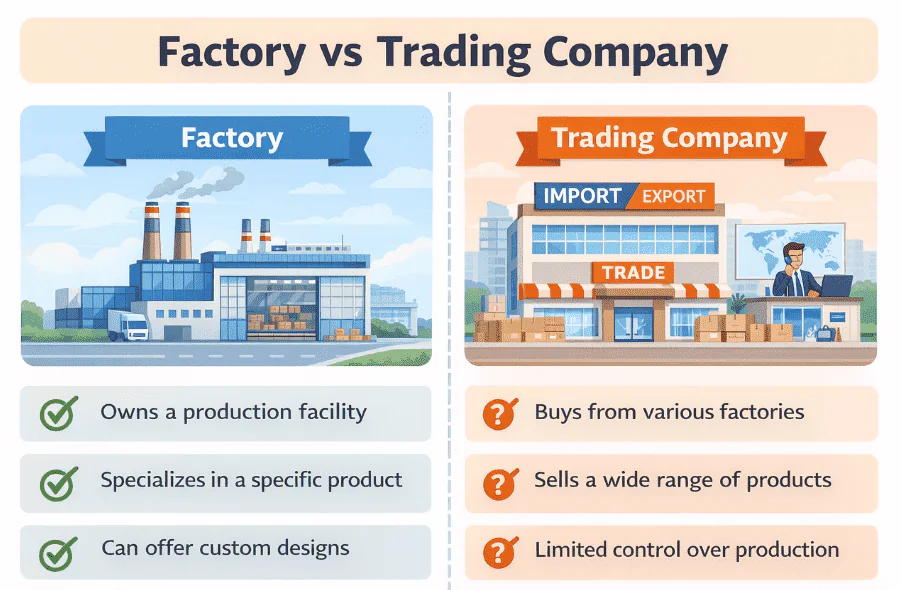
Whenever possible, start conversations with suppliers that appear to be actual manufacturers. These companies usually specialize in a specific product category rather than offering a wide mix of unrelated items. Their staff can often explain production details, materials, and technical specifications with confidence.
Manufacturers also tend to provide clearer information about minimum order quantities (MOQ), lead times, and customization options. Because they control production directly, they can usually discuss product improvements or packaging changes in more detail than trading companies.
Check Booth Size and Presentation
Booth presentation can also offer useful clues. Established suppliers often invest in larger and more organized booths to display their products professionally. They usually provide printed catalogs, specification sheets, and clear product labeling. The staff working at these booths often have defined roles, such as sales representatives or technical specialists.
While a large booth does not automatically guarantee reliability, companies that regularly export products often present their brand and product range more clearly than smaller or temporary exhibitors.
Look for Long-Term Exhibitors
Another positive signal is long-term participation in the fair. Many exhibitors display signs such as “10+ years Canton Fair exhibitor” or highlight their export history in marketing materials. Suppliers that return year after year usually have stable operations and ongoing relationships with international buyers.
Export experience is also important. Companies that regularly ship products overseas understand documentation, certifications, and international quality expectations. This experience can make communication and order management much smoother.
Booth appearance alone is not enough. You still need to ask the right questions before deciding whether a supplier is reliable.
3. Questions to Ask Suppliers at the Canton Fair
Talking to suppliers at the Canton Fair is your best chance to evaluate them quickly. A short conversation can reveal a lot about their experience, production capability, and professionalism.
Instead of only asking for prices, buyers should prepare a few key questions that help determine whether a supplier is reliable and suitable for long-term cooperation.
Are You the Manufacturer or a Trading Company?
This is often the first question buyers ask at the fair. The answer helps you understand how the supplier operates and what role they play in the supply chain.
Some exhibitors represent factories directly, while others are trading companies working with multiple manufacturers. Knowing this early helps you decide what type of partner you are dealing with.
If you want to learn how to identify the difference in detail, you can read our guide on factory vs trading company at the Canton Fair.
What Is Your MOQ and Lead Time?
Minimum order quantity (MOQ) and production lead time are two of the most important details for importers.
Factories usually have clearer MOQ requirements because they plan production in batches. Lead time also tells you how busy the supplier is and whether they have stable manufacturing capacity.
If a supplier cannot give a clear answer, it may indicate that production is handled by another factory.
Do You Have Export Experience?
Export experience is another useful indicator of reliability. Suppliers who regularly ship products overseas usually understand international requirements such as packaging standards, product certifications, and documentation for customs clearance.
Experienced exporters also communicate more efficiently with overseas buyers and are familiar with international logistics processes.
Can You Provide Product Samples?
Samples are essential when evaluating a new supplier. Even if the products look good at the booth, it is still important to test the quality before placing a large order.
By requesting samples, buyers can examine the materials, workmanship, and packaging details more carefully. This step helps reduce sourcing risks and ensures the product meets your market standards.
Quick Tip
Bring a notebook or take photos of supplier booths during the fair. Record the booth number, company name, and key answers to your questions. This makes it much easier to follow up with suppliers after the exhibition.
4. How to Verify a Factory After the Fair
Meeting a supplier at the Canton Fair is only the first step. A professional booth and smooth communication do not guarantee real manufacturing capability.
After the fair, buyers need to verify the company behind the booth before moving forward. This process helps confirm whether the supplier is reliable, stable, and suitable for long-term cooperation.
Confirm the Business Registration
Start by checking the company’s basic registration details. A legitimate supplier should be able to provide a business license and full company name without hesitation.
You should review key information such as the registered address, business scope, and years of operation. These details help you confirm that the company exists and operates within the expected industry.
If the information is incomplete or inconsistent, it is better to pause and verify further before continuing.
Review Product Specifications Carefully
After the fair, request detailed product information instead of relying on what you saw at the booth.
Ask for clear specifications, including materials, dimensions, packaging details, and any relevant certifications. This step ensures that both sides have the same understanding of the product.
A reliable supplier will provide structured and consistent product data. Vague or changing details can lead to problems later in production.
Request Factory Photos or Videos
Visual materials can help you understand the supplier’s production environment. You can ask for photos or videos of production lines, warehouses, and packing areas.
These materials give you a basic idea of the factory’s size, organization, and workflow. While they are not a complete verification method, they are a useful step before deeper checks.
If a supplier cannot provide any factory visuals, you should be cautious.
Order Samples Before Mass Production
Samples are one of the most important steps in supplier verification. They allow you to evaluate product quality before committing to a large order.
When reviewing samples, pay attention to materials, finishing, consistency, and packaging. This is also a good time to test how the supplier handles revisions and feedback.
A reliable supplier will be willing to adjust details and improve the sample based on your requirements.
Arrange a Factory Visit or Third-Party Inspection
For larger orders, a factory visit or inspection is strongly recommended. This is the most direct way to verify production capability.
During a factory visit, you can check production lines, worker setup, quality control processes, and warehouse management. If you cannot visit in person, a third-party inspection service can provide a detailed report.
This step helps confirm whether the supplier can handle your order consistently and at the required quality level.
Check Consistency Across All Information
One simple but effective method is to compare all the information you receive.
Make sure the company name, address, product details, and communication remain consistent across emails, documents, and quotations.
Inconsistent information is often a warning sign. Reliable suppliers usually provide clear and stable details throughout the process.
5. A Verify a Chinese Suppliers Verification Checklist
After the Canton Fair, buyers often follow up with several suppliers at the same time. It is easy to miss important details if you do not have a clear verification process.
A simple checklist can help you stay organized and make better decisions before placing your first order.
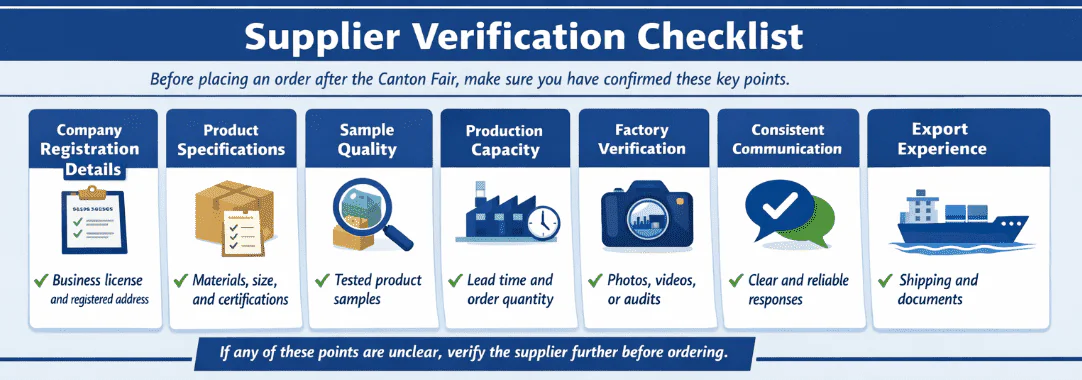
Before moving forward with any supplier, make sure you have confirmed the following points:
- Company registration details
You have checked the business license, company name, and registered address.
- Product specifications
You have received clear information about materials, size, packaging, and certifications.
- Sample quality
You have tested product samples and confirmed they meet your standards.
- Production capacity and lead time
The supplier has provided realistic production timelines and order quantities.
- Factory visuals or verification
You have reviewed factory photos, videos, or inspection reports.
- Communication consistency
The supplier provides clear, stable, and consistent information across all discussions.
- Export experience
The supplier understands international shipping, packaging, and documentation.If several of these points are still unclear, it is better to slow down and verify the supplier further before placing an order.
Taking extra time at this stage can prevent costly mistakes later.
A Quick Tip for Buyers
Do not rely on just one supplier after the Canton Fair. Even if one option looks promising, always compare at least two or three suppliers before making a final decision.
This gives you a better understanding of pricing, quality levels, and service, and helps you choose the most reliable partner.
Conclusion
The Canton Fair is one of the best places to find new suppliers. You can see products in person, compare options, and start real conversations. But choosing the right supplier does not end at the booth.
What you do after the fair matters just as much. Clear questions, proper follow-up, and careful verification help you avoid risks and make better decisions. Taking a little more time at this stage can save you from bigger problems later.
If you are working with multiple suppliers or planning a larger order, having local support makes the process much easier. A sourcing team can verify suppliers, check factories, and follow your order step by step — so you don’t have to manage everything from overseas.
The goal is simple: find a supplier you can trust, not just one that looks good at the fair.